The free foundation has supported AI artists for the last four years, and will continue to do so.
The platform is free for AI artists and the community. Additional features can be provided when you need more capacity, larger file uploads, a dedicated domain, or specialised features to support your practice.
Organisations can use the free platform tools for competitions, open calls, and galleries. Enhanced features are available for larger programmes that require more capacity, additional domains, or advanced functionality.
The Forgotten Gods: When the World Forgot Their Names
The Forgotten Gods is a five-part visual exploration inspired by Slavic mythology, exploring the relationship between humanity, nature, mortality and forgotten beliefs. Through the goddess Morana and the eternal transition between winter and spring, the series reflects on a central question: have the gods disappeared, or have the forces they represent simply outlived our memory of them?
# THE FORGOTTEN GODS
### When the World Forgot Their Names
**Artist: HCreative Studio | Heidi De Koker**
## Artistic Concept
The Forgotten Gods is a five-part visual exploration inspired by Slavic mythology and humanity's ancient relationship with nature, mortality, memory and the unknown.
At the heart of the collection lies a question:
*Did humanity create its gods, or did it simply give names to things it could never fully understand?*
Across generations, humanity has built temples, made offerings and created stories to explain the forces governing existence. Yet beliefs change, civilisations disappear and sacred places fall into ruin.
But winter still comes. Forests continue to grow. Life eventually ends, and spring returns.
Perhaps the gods were never truly gone.
## The Narrative
**01. The Last Offering**
An abandoned shrine stands beneath the weight of winter. A candle burns beside the final offerings, surrounded by snow-covered stone, forgotten symbols and the remains of an ancient sacred place. The absence of worshippers becomes the subject itself. This image represents the gradual disappearance of belief and humanity's fading connection with the sacred.
**02. The Goddess of the Last Winter**
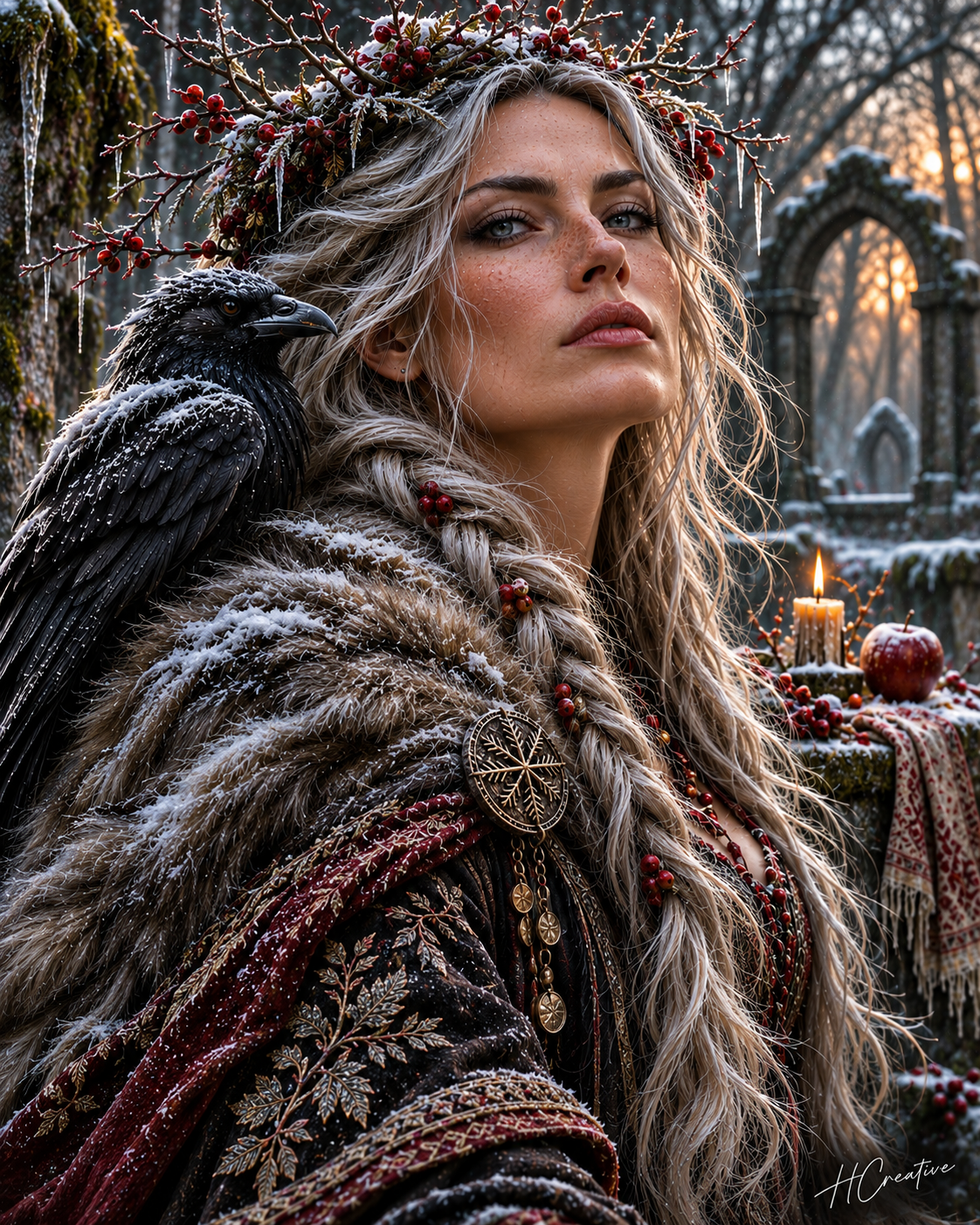
Morana, inspired by the Slavic goddess associated with winter and death, emerges as the central figure of the collection. She is not portrayed as evil or destructive, but as a solemn embodiment of an inevitable part of existence. Her presence represents endings, stillness and the natural necessity of death within the cycle of life.
**03. The Forest Remembers**
An ancient forest reveals faces and figures within its enormous trees. A stag, a wolf and a raven inhabit this forgotten sacred landscape. Nature becomes a keeper of memories, carrying traces of existence long after human generations have disappeared.
**04. The Threshold Between Worlds**
Morana stands at the boundary between winter and spring. Behind her, frost and snow remain, while beyond the ancient gateway a living landscape begins to awaken. This moment represents transition, reminding us that endings and beginnings are inseparable.
**05. When the Gods Awaken**
The final image reveals a world returning to life. Snowdrops and crocuses emerge through melting snow, water flows freely and sunlight reaches the ancient forest. Morana becomes a distant presence as nature continues its eternal cycle. The gods may have been forgotten, but the forces they represent remain.
## Artistic Approach
The collection was developed through a deliberate artistic process, prioritising visual continuity, atmosphere, composition and emotional impact.
The visual language combines dark photorealistic fine art with restrained mythological elements. Particular attention was given to realistic textures, natural lighting, detailed organic materials, believable environments and the emotional presence of the central character.
A consistent visual identity connects all five works through recurring elements: Morana, her raven, ancient stone architecture, winter vegetation, dark crimson berries and the transition between cold and warmth.
The intention was to create images that feel like moments from a forgotten world rather than conventional fantasy illustrations.
## AI and Human Creative Direction
Artificial intelligence was used as a creative image-generation and refinement tool. However, the artistic direction remained human-led throughout the project.
The concept, narrative, symbolism, visual identity, character development, compositional decisions, evaluation and selection of the final images were directed by the artist.
Each artwork underwent an iterative process of review and refinement, with particular attention to realism, anatomical consistency, material detail, lighting and the relationship between individual images and the wider collection.
AI was used as a means of visual exploration, while the final artistic decisions were guided by a deliberate creative vision.
## Closing Reflection
The Forgotten Gods is not an attempt to reconstruct historical Slavic religious practices or illustrate established myths literally. It is an original artistic interpretation inspired by their mythology.
Ultimately, the collection asks viewers to reconsider their relationship with the natural world.
Perhaps humanity has forgotten the names of its gods, but it has never escaped the forces that gave those gods meaning.
The final offering to a forgotten god. - An abandoned winter shrine holds the last traces of humanity's forgotten beliefs.She is not the end. She is part of the eternal cycle. - Morana embodies winter, mortality and the quiet inevitability of endings.
HCreative Studio is an independent digital art studio exploring the intersection of realism, fantasy and visual storytelling.
Our work spans dark romantic portraiture, gothic aesthetics, mythical creatures, wildlife and imaginative fantasy worlds. Each collection is developed around distinctive concepts, expressive visual detail and carefully considered artistic direction.
Using generative AI as part of the creative process, we explore new possibilities in digital illustration, focusing on atmosphere, composition, texture and emotional impact.
Our vision is to create distinctive artwork that captures attention, inspires imagination and brings original creative concepts to life.