AI-ARTS competition
Reimagine — 5th AI-ARTS Competition 2026
Explore Reimagine — 5th AI-ARTS Competition 2026.
Organised by AI-ARTS.
Explore the competition

AI-ARTS competition
Explore Reimagine — 5th AI-ARTS Competition 2026.
Organised by AI-ARTS.
Explore the competitionFree for the AI arts community
The free foundation has supported AI artists for the last four years, and will continue to do so.
The platform is free for AI artists and the community. Additional features can be provided when you need more capacity, larger file uploads, a dedicated domain, or specialised features to support your practice.
Organisations can use the free platform tools for competitions, open calls, and galleries. Enhanced features are available for larger programmes that require more capacity, additional domains, or advanced functionality.
AI-ARTS artwork
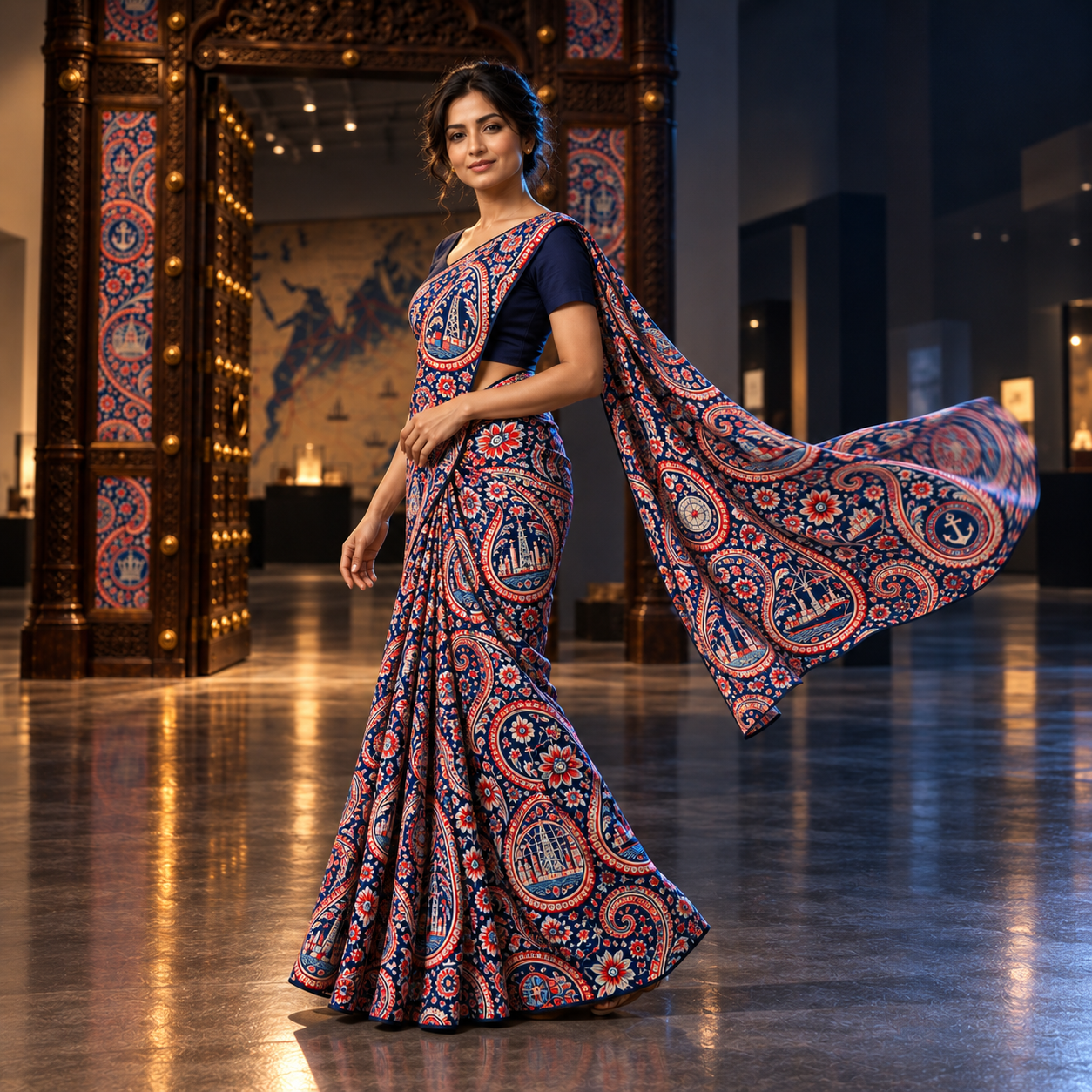
A-Thrice | AI-assisted conceptual installation, digital sculpture, textile design and archival storytelling
Who decides where people belong—and who has the authority to send them away?
Return to Sender is a research-led, mixed-media exhibition concept exploring empire, migration, cultural inheritance and belonging through the interconnected histories of India, East Africa and Britain.
At its visual centre is The Fabric of Empire, an original paisley-inspired textile design that transforms familiar symbols of British identity into objects carrying the hidden infrastructure of imperial commerce.
From a distance, the fabric appears richly decorative, combining postal red, midnight navy and ivory in flowing ornamental patterns. On closer inspection, its paisley forms reveal container ships, port cranes, shipping routes, customs seals, navigational symbols and imperial insignia. The textile collapses centuries of global trade into a single visual language, connecting historical colonial networks to contemporary international commerce.
The exhibition imagines this fabric covering a traditional British telephone box, a Royal Mail pillar box and a collection of antique steamer trunks stacked upon an East African railway luggage trolley.
Each object represents a different mechanism of movement and connection. The railway trolley recalls the labour and infrastructure that supported colonial expansion. The luggage evokes successive migrations and the belongings carried between homes. The pillar box represents the institutions through which imperial administration and intimate family correspondence travelled together.
The telephone box transforms an instantly recognizable symbol of Britain into a portal to East African cultural history. In the proposed interactive installation, lifting its receiver would activate music and oral histories reflecting the interconnected communities of the Indian Ocean.
A Zanzibar-inspired carved doorway introduces visitors to the cultural and commercial networks that existed before British colonial rule. An ornate red Bombay-style chest remains deliberately uncovered, acknowledging a material tradition already shaped by exchange between cultures.
Alongside these objects, archival photographs, letters, family histories and community records restore individual experiences to narratives often dominated by institutions, maps and economic systems.
The project draws upon the artist's own East African Indian family history, including migration across multiple generations and the experience of navigating national identities and immigration systems.
The title Return to Sender transforms an ordinary postal instruction into a political question. A letter can be returned to its point of origin, but can a person whose family has lived across continents for generations be assigned a single place to which they must return?
AI-assisted visualisation allows the artist to develop an imagined installation in which historic objects, contemporary textile design and architectural environments coexist. The resulting imagery presents a proposed artistic environment rather than documentation of a physically realised exhibition.
Ultimately, Return to Sender challenges the idea that national identity exists independently of migration. It reveals how the objects we associate with particular countries are themselves products of centuries of exchange, labour, movement and cultural adaptation.
The work asks viewers to reconsider not only where people come from, but who possesses the power to determine where they are permitted to belong.
@a-thrice
A-Thrice is a London-based multidisciplinary artist making alternative political hip-hop, conceptual installations, textile prints and research-driven visual work. The projects explore power, identity, migration, democracy, technology and the stories that become ordinary when systems are left unquestioned. The practice moves between intimate histories and institutional machinery. A lyric might become a map; a textile might hide a port; a decorative hat might open a question about military spectacle. Across the media, the work combines satire, curiosity, visual pleasure and a demand to look again. The songwriting and artistic concepts are developed by A-Thrice. AI-assisted tools are used in parts of music production and digital image-making. The resulting artworks and exhibition environments are presented as creative works, not documentary photographs of physical installations.
publicationRecordDated
publicationRecordPresented
Private review notes and submission details remain private.
Not rated yet.
Selected from meaningful public signals such as the artist, released competitions, work type, categories, tags and title.


Recent public works from the AI-ARTS Gallery.