AI-ARTS competition
Reimagine — 5th AI-ARTS Competition 2026
Explore Reimagine — 5th AI-ARTS Competition 2026.
Organised by AI-ARTS.
Explore the competitionAI-ARTS competition
Explore Reimagine — 5th AI-ARTS Competition 2026.
Organised by AI-ARTS.
Explore the competitionFree for the AI arts community
The free foundation has supported AI artists for the last four years, and will continue to do so.
The platform is free for AI artists and the community. Additional features can be provided when you need more capacity, larger file uploads, a dedicated domain, or specialised features to support your practice.
Organisations can use the free platform tools for competitions, open calls, and galleries. Enhanced features are available for larger programmes that require more capacity, additional domains, or advanced functionality.
AI-ARTS artwork
Five shops in an old Seoul neighbourhood, all of them closed — a snack bar, a hardware store, a coin laundry, a stationery shop, and the shop of a man who has come back to stand in front of it. One rule holds the series together: the glass of each window does not reflect the present. It shows the shop as it was when it was trading, lit by the same single light that falls on the closed street outside.
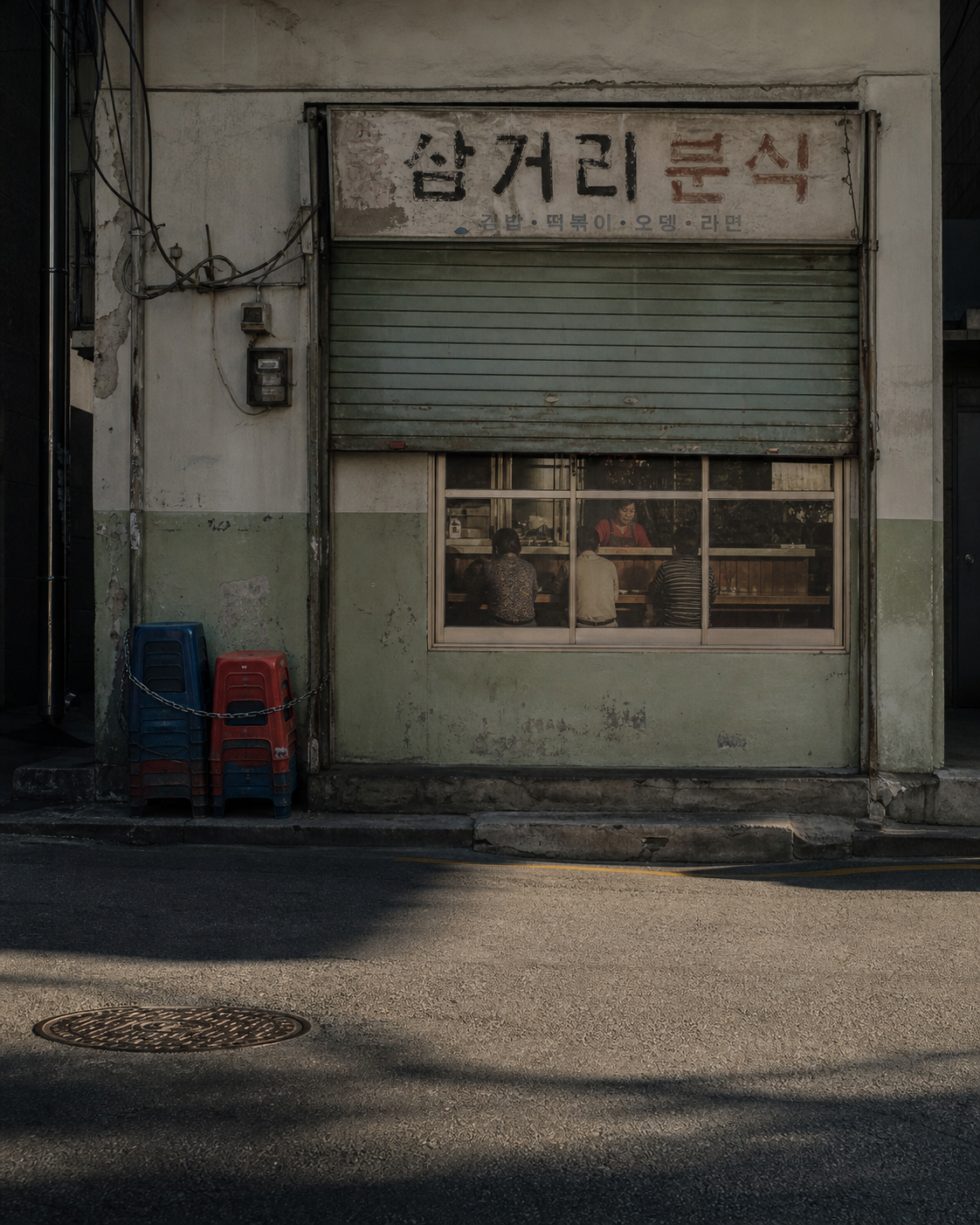
Five shops in an old Seoul neighbourhood, all of them closed. A snack bar with its plastic stools chained to a pole, a hardware store, a coin laundry, a stationery shop — and the shop of a man who has come back to stand in front of it.
One rule holds the series together: the glass of each window does not reflect the present. It shows the shop as it was when it was trading — customers at the counter, a young man folding washing, children in school uniform crowding a display case of pencils — lit by the same single light that falls on the closed street outside. Everything else in the frame obeys ordinary physics. The shutters are dented, the paint is flaking, the shadows run at the same angle across the pavement. Only the window is in the wrong time.The last image turns the rule back on the viewer. The man is the only figure outside the glass, and the window shows the room exactly as it was, without him. What is left of him in the present is his shadow on the empty asphalt — cast by a low sun that has already gone.
The series is about shops that close without an announcement, and about streets that keep showing you what used to be sold on them.
The rule I broke: The window carries light from another decade and no light from the present. In the final frame the man casts a shadow but has no reflection — the glass holds the room but not the person standing in front of it.Images in order:
1. Snack bar — 삼거리 분식: shutter down, stools chained outside; behind the glass, the counter full at lunch.
2. Hardware store — 삼정철물: shutter down; in the door glass, three men over the shelves, hose coiled in the doorway.
3. Coin laundry — blue frontage closed; an old woman waits on a plastic chair while a young man folds washing in front of the machines.
4. Stationery shop — closed under a green awning; schoolchildren at the display case, the owner leaning in over pencils and notebooks.
5. Return — a grey-haired man before his former shop; the window shows the room as it was, and he is not in it. His shadow alone on the road.
Camera and light: 4:5 vertical frames at eye level throughout, one warm low source per frame, the shop held against a large share of empty street.
How AI contributed: AI image generation model, directed through structured prompt design. I wrote each frame as a shot — the shop and its sign, the scene inside the glass, the camera height and distance, the one light source and its colour temperature, and how much empty street the frame is allowed. I selected the composition among variations and graded the final colour by hand. No other artist's name or style was used in any prompt, and no existing photograph was used as an input.
Five shops in an old Seoul neighbourhood, all of them closed — a snack bar, a hardware store, a coin laundry, a stationery shop, and the shop of a man who has come back to stand in front of it. One rule holds the series together: the glass of each window does not reflect the present. It shows the shop as it was when it was trading, lit by the same single light that falls on the closed street outside.
Five shops in an old Seoul neighbourhood, all of them closed. A snack bar with its plastic stools chained to a pole, a hardware store, a coin laundry, a stationery shop — and the shop of a man who has come back to stand in front of it.
One rule holds the series together: the glass of each window does not reflect the present. It shows the shop as it was when it was trading — customers at the counter, a young man folding washing, children in school uniform crowding a display case of pencils — lit by the same single light that falls on the closed street outside. Everything else in the frame obeys ordinary physics. The shutters are dented, the paint is flaking, the shadows run at the same angle across the pavement. Only the window is in the wrong time.The last image turns the rule back on the viewer. The man is the only figure outside the glass, and the window shows the room exactly as it was, without him. What is left of him in the present is his shadow on the empty asphalt — cast by a low sun that has already gone.
The series is about shops that close without an announcement, and about streets that keep showing you what used to be sold on them.
The rule I broke: The window carries light from another decade and no light from the present. In the final frame the man casts a shadow but has no reflection — the glass holds the room but not the person standing in front of it.Images in order:
1. Snack bar — 삼거리 분식: shutter down, stools chained outside; behind the glass, the counter full at lunch.
2. Hardware store — 삼정철물: shutter down; in the door glass, three men over the shelves, hose coiled in the doorway.
3. Coin laundry — blue frontage closed; an old woman waits on a plastic chair while a young man folds washing in front of the machines.
4. Stationery shop — closed under a green awning; schoolchildren at the display case, the owner leaning in over pencils and notebooks.
5. Return — a grey-haired man before his former shop; the window shows the room as it was, and he is not in it. His shadow alone on the road.
Camera and light: 4:5 vertical frames at eye level throughout, one warm low source per frame, the shop held against a large share of empty street.
How AI contributed: AI image generation model, directed through structured prompt design. I wrote each frame as a shot — the shop and its sign, the scene inside the glass, the camera height and distance, the one light source and its colour temperature, and how much empty street the frame is allowed. I selected the composition among variations and graded the final colour by hand. No other artist's name or style was used in any prompt, and no existing photograph was used as an input.
Published on Nov 27, 2026 after review and an explicit publication decision.
Presented in AI-ARTS Gallery.
Private review notes and submission details remain private.
Not rated yet.
Selected from meaningful public signals such as the artist, released competitions, work type, categories, tags and title.


Recent public works from the AI-ARTS Gallery.